
In This Article
A Piece Built Around Symmetry
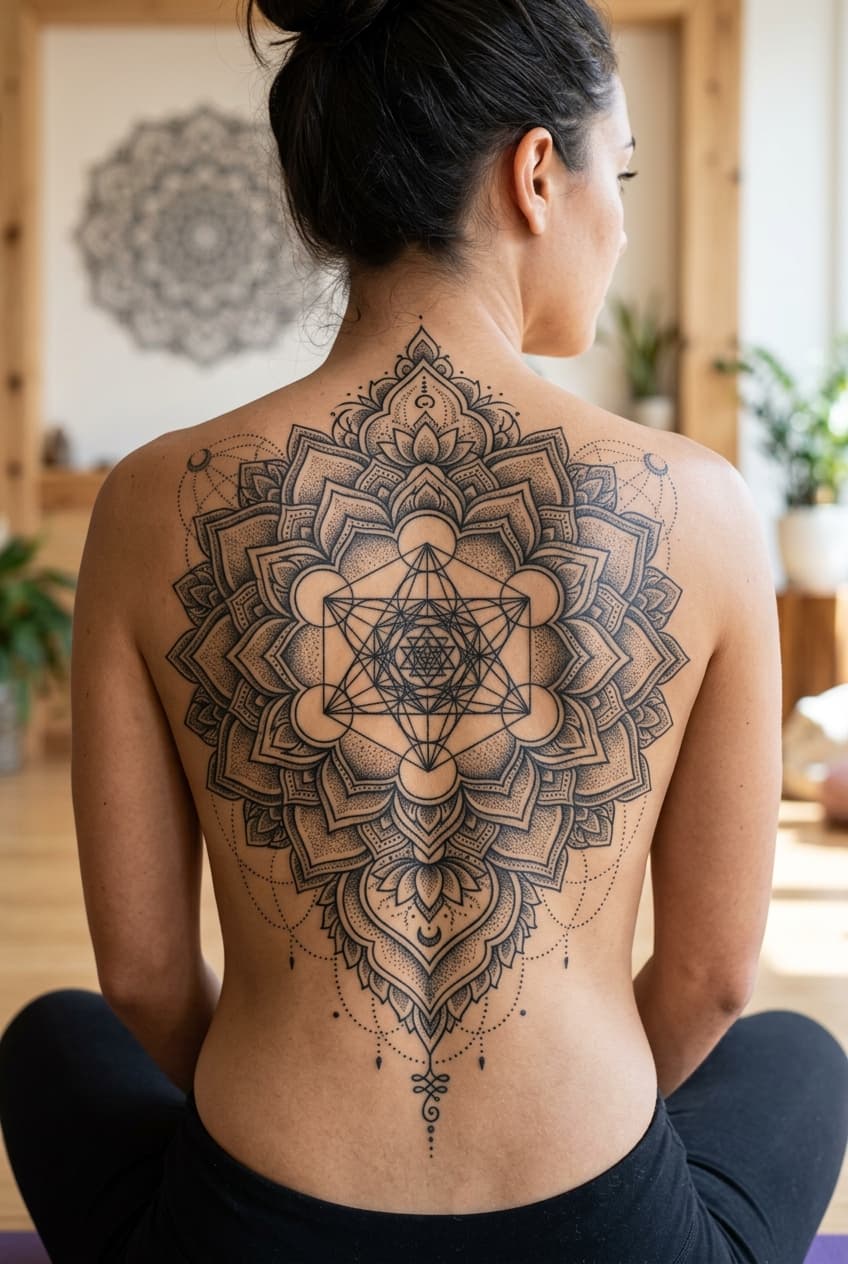
This mandala spans the full length of the spine, built from concentric rings of repeating geometric motifs. Unlike most tattoo styles, sacred geometry work lives or dies on precision — a single ring that drifts a few degrees off-axis is immediately visible.
The Math Behind the Design
Every ring in a mandala like this is built on radial symmetry — the same motif repeated at equal angles around a central point, usually 6, 8, or 12-fold. Getting that spacing consistent by hand requires careful stencil work and a steady dotwork or fine-line technique, since any variation in dot density between repeated sections breaks the illusion of perfect symmetry.
Why Mandalas Represent Balance
Rooted in centuries-old spiritual traditions, mandalas are traditionally read as representations of cosmic order, meditation, and inner balance. Clients often choose a back placement specifically because it lets the design's symmetry follow the body's own centerline along the spine.
Why the Back Works So Well
The back offers one of the flattest, largest continuous canvases on the body, which is exactly what radial symmetry needs to read correctly. Placing the same design somewhere curved, like the shoulder or ribs, would distort the outer rings.
Planning for Multiple Sessions
A back piece at this scale typically takes 2-4 sessions depending on ring count and dot density. We space sessions roughly 3-4 weeks apart to let the skin heal fully before layering additional detail nearby.
Key Takeaways
- Expect 2-4 sessions for a full spine mandala at this scale.
- Precision stencil placement matters more here than in almost any other style.
- The back and chest are the two best placements for large radial-symmetry work.
Frequently Asked Questions
How many sessions does a piece like this take?
Most full-back mandalas of this scale take between 2 and 4 sessions, spaced several weeks apart to allow proper healing between sittings.
Does tattooing along the spine hurt more?
Yes, the spine and areas directly over bone tend to rank higher on the pain scale than fleshier areas, though most clients find it manageable with breaks between sections.


